
What cybersecurity risks are most relevant to businesses in Reno?
Reno businesses are most often hurt by credential theft, business email compromise, remote access exposure, data-handling mistakes, and weak recovery planning because these issues interrupt operations quickly and can trigger fraud, downtime, legal obligations, and expensive cleanup.
At 8:12 a.m., Audrey E. walked into a Reno office to find vendor invoices rerouted after a finance mailbox was taken over through a reused password and dormant legacy email access; payroll was delayed, outbound payments were frozen, and the week’s disruption reached $77,600.
This opening scenario is derived from real operational incidents observed in managed IT environments. Names and identifying details have been modified for confidentiality.


About the Author: Scott Morris
Scott Morris is an experienced IT and cybersecurity professional with 16 years of hands-on experience in managed technology services. He specializes in What cybersecurity risks are most relevant to businesses in Reno? and has spent his career building practical recovery, security, and operational continuity processes for businesses across Nevada.
Scott Morris is a managed IT and cybersecurity professional who helps Reno and Sparks businesses secure user identities, stabilize infrastructure, document systems, and recover from outages and security incidents. Scott Morris has 16+ years of managed IT and cybersecurity experience. That experience is directly relevant to this topic because the risks that hurt local businesses most are usually not abstract threats; they are operational failures around email security, remote access, patch discipline, recovery readiness, and response ownership, and competent technology management reduces downtime, security exposure, and avoidable business disruption.
The discussion below is intended to help decision-makers evaluate common risk patterns, controls, and warning signs in a practical way. This is general technical information; specific network environments and compliance obligations change strategy.
For most Reno businesses, the relevant cybersecurity question is not whether a sophisticated adversary has singled them out; it is whether ordinary control failures can stop payroll, redirect money, expose customer records, or leave staff unable to work. The exposures seen most often in real business environments are credential theft, business email compromise, exposed remote access, unmanaged endpoints, weak vendor access, and poor handling of personal information covered by Nevada Revised Statutes NRS 603A, which requires reasonable security measures and creates breach-notification obligations when personal data is exposed.
- Identity-based fraud: Attackers target email, Microsoft 365, and VPN accounts because user identity is often the fastest path to financial systems and internal trust.
- Email compromise: A single mailbox can expose invoices, approval chains, customer conversations, and document-sharing links that let fraud look legitimate.
- Remote access exposure: Firewalls, remote desktop tools, and unmanaged home or field devices become weak points when patching and access reviews fall behind.
- Recovery and continuity gaps: Even when backups or security tools exist, poor testing and unclear ownership can turn a manageable incident into prolonged downtime.
In mature environments, these risks are reduced through layered controls and disciplined operations rather than one product. A common failure point is assuming the firewall or antivirus is the security strategy, when the larger problem is missing ownership over patching, access changes, alert response, and documentation. That is where structured managed IT services often support operational resilience, because the work is recurring and verifiable instead of informal and reactive.
What cybersecurity risks matter most for Reno businesses?

The risks that matter most are the ones most likely to interrupt business operations within the way Reno companies actually work: cloud email used for approvals and finance, remote logins from job sites or home offices, line-of-business applications that have not been reviewed recently, and small internal teams wearing too many hats. In practice, credential theft sits at the front of the list because once one mailbox or admin account is compromised, the attacker can read conversations, insert fraudulent payment instructions, pivot into shared files, and use trust that already exists inside the business.
Why do these risks create larger business consequences than many owners expect?
These incidents usually become expensive for reasons that are not obvious at the moment of compromise. A taken-over mailbox can freeze accounts payable, delay payroll, and force accounting review; an unpatched firewall can cut off remote access to dispatch or accounting; and a compromised endpoint can expose files that trigger legal and notification work. What usually separates a stable environment from a fragile one is not whether malware or fraud attempts appear, but whether the company can contain the problem quickly without losing workflow, cash movement, or customer confidence.
Which controls reduce the most common entry points?
The highest-value controls are identity controls first, then endpoint and remote access discipline. Guidance in NIST SP 800-63B exists because authentication fails when accounts are not managed consistently across their full lifecycle; in business terms, that means multifactor authentication must be enforced for every privileged and finance-related account, legacy email protocols should be disabled, passwords should not be reused, and former employees or vendors must be removed promptly. Add endpoint detection, prompt security patching for firewalls and operating systems, and restricted administrative rights, and many common Reno attack paths become much harder to exploit.
How does competent cybersecurity management work in practice?
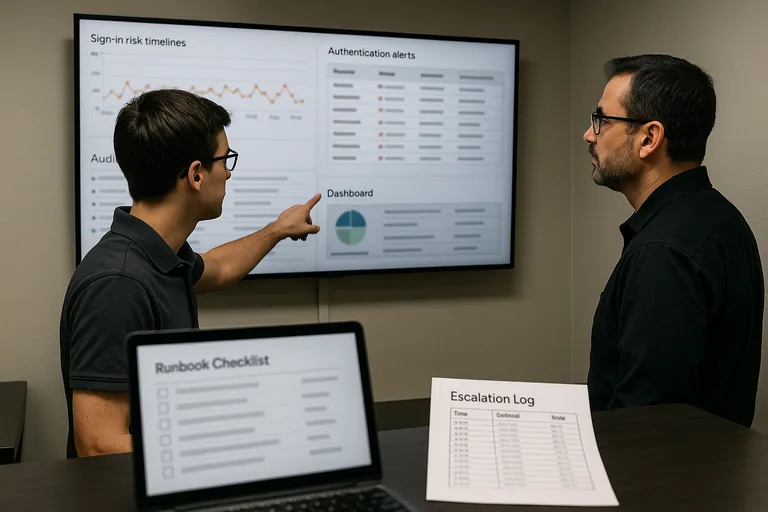
Competent cybersecurity management is repetitive operational work. Systems should be inventoried, endpoints enrolled in policy, patches staged and tracked, sign-in logs reviewed, mailbox rules audited, and security alerts triaged through a documented escalation workflow that shows who responds and within what timeframe. During a routine Microsoft 365 review, repeated successful logins from Nevada and overseas within minutes can trigger investigation; in poorly governed environments, the underlying issue is often a forgotten shared mailbox or device account still using legacy IMAP, which bypasses the intended MFA policy. In practice, the issue is rarely the tool alone; it is the process around it, including exception handling, ownership, and follow-up.
What evidence shows that protections are real rather than assumed?
A mature environment produces evidence. That includes monthly patch compliance reports, endpoint health status showing which devices are actually checking in, sign-in risk logs, reviewed lists of administrative accounts, documentation of mailbox forwarding audits, vulnerability scan summaries, and backup restore test records for systems the business cannot live without. A monitoring system may generate alerts, but competent teams also keep escalation records and incident timelines; without that evidence, businesses often assume someone is watching when the alerts are actually misrouted, ignored, or left unresolved.
What should a Reno business ask an IT provider or internal team?
When does weak implementation become dangerous, and what should happen next?
Weak implementation becomes dangerous when security exists on paper but not in enforcement. Common examples are MFA turned on for staff but exempted for service accounts, endpoint protection installed on most devices but not servers, former vendor access never reviewed, or backups reported as successful even though no one has mapped which systems must be restored first. If the current state is unclear, the next step is not to buy another tool; it is to establish ownership, document the environment, rank the highest-impact risks, and close the gaps that affect operations first. Businesses that need that level of ongoing discipline usually look at managed IT support with recurring security oversight so controls, reviews, and response duties stay consistent over time.