Reno Plant Audit
Seeing encrypted files is often the visible symptom of legacy tools, not the root problem itself. In manufacturing plants across Reno, issues like legacy systems, patchwork fixes, and hard-to-adopt tools can quietly undermine backup and disaster recovery until work stops or risk spikes. The fix usually starts with simplifying the stack and making modernization practical.
This case study reflects real breakdown patterns documented across 300+ regional IT incidents. Names and identifying details have been modified for confidentiality, while technical and financial data remain accurate to the original events.

Why Encrypted Files in Reno Manufacturing Usually Point to an Innovation Wall
When a Reno manufacturing plant reports encrypted files, the immediate assumption is often ransomware alone. Sometimes that is true, but in practice we usually find a broader operational failure. The Innovation Wall shows up when older hardware, outdated operating systems, and disconnected backup tools cannot support current security controls, cloud workflows, or modern recovery expectations. The result is a plant that looks functional during normal production but fails hard when a file server, workstation group, or line-of-business application is hit.
That matters in manufacturing because file access is tied directly to scheduling, quality records, purchasing, shipping, and machine-side documentation. Once those systems are disrupted, the business impact spreads quickly across shifts. In Northern Nevada, we also see added complexity from mixed environments: older CNC support systems, vendor-managed devices that are rarely patched, and remote access methods left in place long after they should have been retired. Businesses trying to prevent repeat downtime often need structured backup and disaster recovery support in Reno that is built around actual recovery testing, not just successful-looking backup logs. In cases like this, the encrypted files are only the symptom; the root cause is usually a stack that has been patched together over years without a clear modernization path.
- Legacy infrastructure: Older servers, unsupported NAS devices, and line-of-business systems often cannot run current endpoint protection, immutable backup controls, or reliable snapshot-based recovery.
- Patchwork fixes: Temporary shares, local USB backups, and one-off admin exceptions create blind spots that make containment and restoration slower.
- Hard-to-adopt tools: If backup, security, and file access platforms are too complex for plant staff to use consistently, recovery steps are skipped until an incident exposes the gap.
- Operational spread: As with the earlier incident involving Emerson, one encrypted file share can quickly disrupt production planning, shipping paperwork, and internal reporting across the floor.
Practical Remediation for Legacy Backup and Recovery Gaps
The fix is rarely a single product swap. We typically start by identifying which systems are business-critical, which ones are merely old, and which ones are both old and critical. From there, the goal is to simplify the stack so recovery becomes predictable. That often means replacing fragile backup chains, separating production systems from general office access, tightening administrative permissions, and validating that restores actually work under time pressure. For manufacturers facing this kind of stall point, a structured technology advisory and assessment process helps prioritize what must be modernized first instead of trying to replace everything at once.
Good remediation also includes security controls that fit plant operations. We commonly recommend MFA hardening for remote access, EDR on supported endpoints, network segmentation between office and production assets where feasible, and backup validation against realistic recovery objectives. Guidance from CISA’s ransomware resilience resources aligns well with what works in the field: isolate what matters, reduce privilege, protect backups, and test restoration before an event forces the issue.
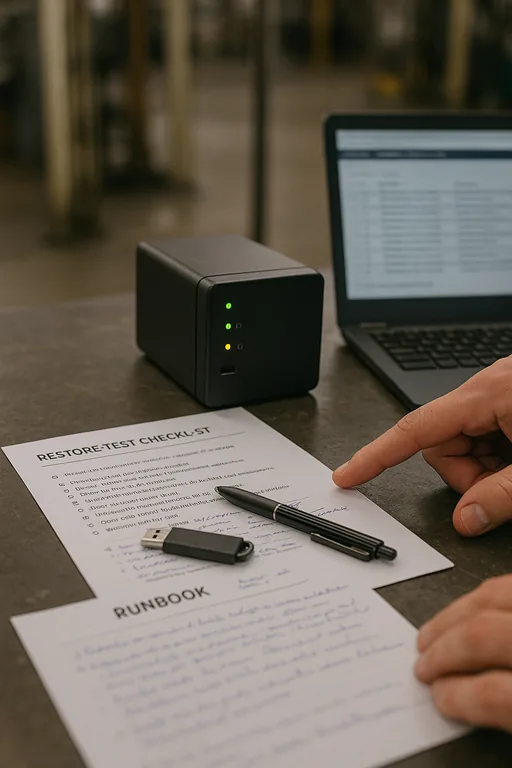
- Backup validation: Run scheduled restore tests for file shares, ERP data, and production documentation so recovery time is measured, not assumed.
- Segmentation: Separate user workstations, servers, and production-adjacent devices to limit how far encryption or credential abuse can spread.
- MFA and admin control: Remove shared admin accounts, enforce MFA on remote access, and restrict elevated permissions to approved workflows.
- Modernization roadmap: Use phased replacement planning so unsupported hardware and software are retired without disrupting plant output.
Field Evidence: Recovery Stability After Legacy File Infrastructure Cleanup
We worked through a similar pattern with a Northern Nevada operation running a mix of aging Windows servers, local backup appliances, and undocumented file-share dependencies. Before remediation, the company had backup jobs that appeared successful but could not restore current production folders cleanly. A single storage issue forced staff to pause document retrieval, reprint traveler packets, and manually verify revision history across departments. The site also had to coordinate around carrier pickup windows, which is a common pressure point for plants moving product through the Reno-Sparks corridor.
After simplifying the backup chain, documenting dependencies, and aligning replacement timing with a broader IT strategy engagement for multi-system modernization , the environment became much more predictable. Restore testing moved from ad hoc to scheduled, unsupported devices were isolated for replacement, and leadership had a clearer view of what could be recovered and how fast.
- Result: Recovery testing improved from uncertain manual restores to verified file-share recovery in under 90 minutes, with a measured reduction in unplanned documentation downtime during subsequent incidents.
Manufacturing Backup and Recovery Risk Reference
Scott Morris is an experienced IT and cybersecurity professional with 16 years of hands-on experience in managed technology services. He specializes in Backup And Disaster Recovery and has spent his career building practical recovery, security, and operational continuity processes for businesses across Reno, Sparks, Carson City, Lake Tahoe, and Northern Nevada and Northern Nevada.


About the Author: Scott Morris
Local Support in Reno and Northern Nevada
Manufacturing plants in Reno often need fast, practical support when file access, backup integrity, or recovery timing starts affecting production. From our Ryland Street office, the Bartley Ranch area is typically about 13 minutes away under normal conditions, which matters when leadership needs on-site coordination around servers, workstations, and plant documentation workflows. Local support is most effective when it combines response speed with a clear understanding of how Northern Nevada facilities actually operate.
What Manufacturing Leaders Should Take Away
Encrypted files in a Reno plant usually indicate that backup and recovery controls have fallen behind the way the business actually operates. Legacy hardware, undocumented dependencies, and years of temporary fixes create an environment where one disruption can spread from file access into scheduling, shipping, and reporting. The right response is not guesswork or another isolated tool purchase. It is a practical review of what must be recovered, how fast it must come back, and which older systems are blocking that outcome.
When we assess these environments, the most valuable improvements are usually straightforward: simplify the stack, verify restores, reduce privilege, and phase out unsupported systems before they become the next outage. That approach is especially important for Northern Nevada manufacturers trying to keep production moving while modernizing carefully.