
Multi-Location Businesses
Multi-location businesses need more than internet connections between offices. They need consistent security, documented support, and site-by-site accountability so leadership can operate across branches without hidden gaps in access, uptime, compliance, or recovery.
When Aleysha E. reviewed why three branch locations stopped processing same-day orders, the issue was not the ISP outage first reported. A stale site-to-site VPN route and shared administrative credentials let an attacker disable the inventory sync service, creating 14 hours of disruption and $61,750 in lost sales, emergency labor, and recovery work.
The following situation represents a realistic incident pattern derived from real business IT environments. Identifying details have been changed to preserve confidentiality.

About the Author: Scott Morris
Scott Morris is an experienced IT and cybersecurity professional with 16 years of hands-on experience in managed technology services. He specializes in Multi-Location Businesses and has spent his career building practical recovery, security, and operational continuity processes for businesses across Nevada.
Scott Morris is a managed IT and cybersecurity professional who helps businesses manage infrastructure across offices, secure identity and network access, maintain stable systems, and recover cleanly when outages or security events affect multiple sites. Scott Morris has 16+ years of managed IT and cybersecurity experience. That operational background is directly relevant to Multi-Location Businesses because branch connectivity, inconsistent endpoint standards, undocumented exceptions, and weak recovery planning often increase downtime and security exposure unless experienced IT teams enforce practical risk reduction, business continuity, secure infrastructure management, recovery readiness, and operational resilience across every location, including Reno and Sparks business technology environments.
The guidance below is intended to help business leaders evaluate operational risk, not replace a site-specific assessment. This is general technical information; specific network environments and compliance obligations change strategy.
From an IT perspective, a multi-location business is not defined by branch count alone; it is defined by repeated infrastructure and repeated ways to fail. Each site adds internet circuits, firewalls, wireless networks, local devices, users, vendors, and support exceptions. That is why mature managed IT services for multi-site environments focus on standardization, central visibility, and documented ownership rather than treating each office as an isolated small network.
The operational challenge is that leadership expects one business experience while technology often behaves like several loosely connected businesses. A common failure point is branch-by-branch customization: a different copier scan path here, an old firewall there, a shared admin account somewhere else. Even small businesses with two or three locations need a consistent model for access, patching, support, and recovery, because once staff move between sites or cloud applications rely on site connectivity, a weak branch can disrupt the whole company.
What makes a business multi-location from an IT and cybersecurity perspective?
A business becomes multi-location in technical terms when users, devices, applications, and data depend on more than one physical site to operate normally. That changes the support model from local troubleshooting to distributed control: identity has to follow staff between locations, network standards have to stay consistent, and outages have to be triaged with enough documentation to know which site, vendor, or connection is actually failing. What usually separates a stable environment from a fragile one is whether those dependencies are designed intentionally or discovered during an outage.
Why do multiple sites increase operational risk?
Multiple sites increase risk because distance hides inconsistency. In environments that have not been reviewed recently, one branch may be patched on schedule while another is months behind, one office may enforce multifactor authentication while another still relies on remembered passwords, and one site may have labeled network equipment while another has an unlabeled closet nobody wants to touch. The business consequence is delayed diagnosis: leadership sees one problem, but operations are really dealing with several different support standards, several different failure points, and unclear ownership when something breaks.
Which failures usually disrupt multi-location businesses first?
- Identity drift: Staff keep access after transfers, role changes, or terminations, creating unauthorized entry points across sites.
- Configuration inconsistency: One branch receives a firewall rule, wireless exception, or vendor shortcut that bypasses standards and becomes the easiest path into the business.
- Local single points of failure: A switch, circuit, access point, or line-of-business terminal fails at one location and stops revenue there even while the rest of the company is healthy.
- Documentation gaps: During an outage, nobody knows which ISP, vendor, rack, or cabinet supports that branch, so recovery drags while the location is already down.
How should a competent multi-location environment work in practice?
In a competent design, branches follow the same baseline: named network equipment, centrally managed firewalls, standardized wireless, endpoint policies, monitored tunnels to core services or cloud platforms, and identity controls that are enforced the same way regardless of site. Guidance in NIST SP 800-207 Zero Trust Architecture matters here because it treats every access request as something to verify, not something to trust just because it came from a branch network; in business terms, that reduces the chance that one compromised location can move quietly into the rest of the company. During a routine review, a packet-loss alert at one office initially looked like a carrier problem, but the underlying issue was an unmanaged switch installed locally that bridged a guest VLAN into the business network. That type of finding is common in environments without disciplined ongoing IT management, and the control that prevents it is a documented branch template backed by monitoring, change approval, and clear device ownership.

What evidence shows the environment is being managed properly?
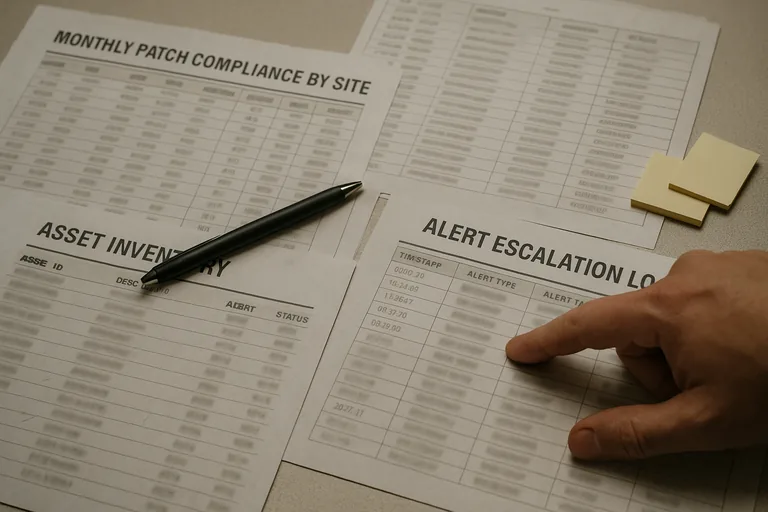
Real evidence looks like monthly patch compliance reports by site, an accurate asset inventory showing who owns each firewall and circuit, alert escalation records proving someone responded, access review logs for transferred employees, and change records showing when a branch rule or wireless setting changed. A monitoring system should generate alerts, but competent teams also maintain documented escalation workflows and exception tracking so leadership can see whether recurring issues are being fixed or merely acknowledged. Without those records, organizations often assume all locations are under the same standard when they are actually relying on informal habits and memory.
When does weak implementation become dangerous?
Weak implementation becomes dangerous when one site is treated as temporary and never brought into the same standards as headquarters. In practice, this is where shared local administrator passwords, unreviewed vendor remote access, copied firewall rules, and unsupported hardware tend to remain for years. Once a compromised account reaches a flat network, phone systems, shared file access, cloud sync processes, and site-to-site connectivity can all be affected from the weakest branch. A common failure point is not the tool alone; it is the absence of review, ownership, and enforcement around the tool.
What should leadership do next if branch technology feels inconsistent?
Leadership should start with a branch-by-branch review and ask a few blunt questions: Do all sites use the same access standards? Who owns each ISP, firewall, and vendor relationship? Can the business keep operating if one branch loses connectivity? Are alerts reviewed with named responsibility? Where is the evidence that changes, patches, and user access are verified? If those answers are unclear, a structured review of multi-site IT operations is usually the fastest way to find hidden fragility before an outage, audit issue, or security event forces the review under pressure.