
How quickly should a local IT provider respond to urgent issues?
Urgent IT problems should be acknowledged quickly, triaged correctly, and escalated with clear ownership. This article explains realistic response expectations, what mature providers do in the first hour, and how Reno businesses can judge whether support reliability is real.
At 8:17 a.m., Aurora P.’s office lost access to scheduling and billing when a virtual host storage array shifted into read-only mode after earlier disk alerts were missed. The local provider did not acknowledge the escalation for 94 minutes, operations stalled, same-day work could not be processed, and the disruption ultimately carried a documented $78,000 consequence in delayed revenue, cleanup, and recovery labor.
This story is based on a real business technology support pattern: the kind of operational breakdown that often becomes visible only after systems, staff, vendors, and workflows are already under strain. Names, dates, timelines, and identifying details have been anonymized or modified for confidentiality, while preserving the practical lessons behind the scenario.


About the Author: Scott Morris
Scott Morris is an experienced IT and cybersecurity professional with 16 years of hands-on experience in managed technology services. He specializes in How quickly should a local IT provider respond to urgent issues? and has spent his career building practical recovery, security, and operational continuity processes for businesses across Nevada.
Business owners reading this are hearing the perspective of Scott Morris, a managed IT and cybersecurity professional who helps businesses manage infrastructure stability, reduce cyber risk, maintain secure systems, and recover operations when incidents interrupt normal work. Scott Morris has 16+ years of managed IT and cybersecurity experience. That experience is relevant here because urgent support is not measured by a slogan; in real business environments it is measured by how quickly issues are acknowledged, triaged, contained, documented, and communicated in ways that reduce downtime, security exposure, and continuity risk for Reno and Sparks business technology environments.
This is general technical information; specific network environments and compliance obligations change strategy. Response targets should be set against actual business impact, internal staffing, vendor dependencies, and documented continuity requirements.
For most businesses, urgent response should be measured in two parts: acknowledgment and active technical engagement. A business-stopping outage or suspected security event should usually be acknowledged within 15 minutes and worked immediately, while severe degradation affecting many users should usually see human response within 30 to 60 minutes. Full resolution can take longer, but waiting hours just to confirm ownership is where preventable loss begins.
Local presence can help when hardware replacement or onsite troubleshooting is required, but urgent incidents are usually won or lost by remote access readiness, current documentation, on-call coverage, and disciplined escalation. That is why mature managed IT support models focus on monitoring, ticket prioritization, and incident ownership instead of relying only on geography.
When comparing providers, ask them to define priority levels, first-response targets, escalation paths, after-hours handling, and communication intervals in plain language. A useful related evaluation appears in what Reno businesses should look for in a managed IT services provider, because response quality depends as much on process discipline as on technician availability.
How fast should urgent response actually be?

For an office-wide outage, line-of-business application failure, internet loss, server login failure, or active cybersecurity event, a competent local provider should usually acknowledge the issue within 15 minutes and begin active triage immediately. For serious but not fully blocking problems, such as major slowness across several users, 30 minutes is often a reasonable ceiling. In practice, the issue is rarely the tool alone; it is whether someone with authority is engaged, diagnostics are underway, and business leadership knows what is happening. A common failure point is contracts that promise a response but never define whether that means an automated ticket email, a dispatcher note, or an engineer actually working the incident.
What counts as an urgent issue instead of a routine support ticket?
Why does the first hour matter so much?
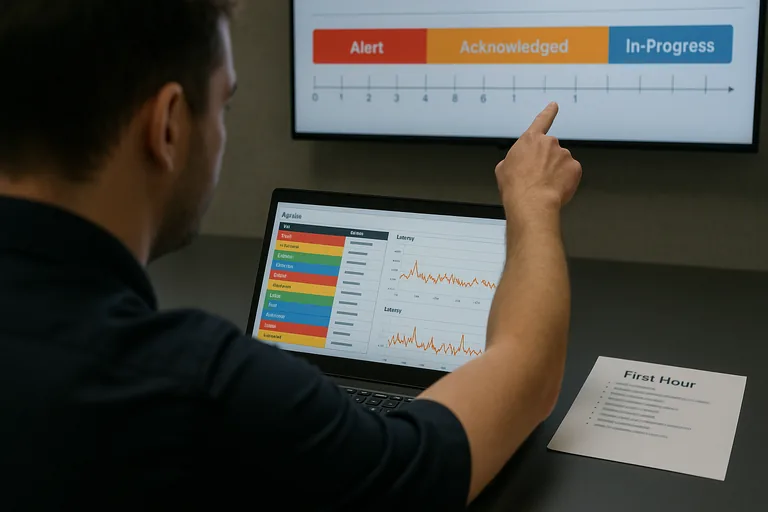
Minutes matter because the first hour often determines whether the event stays contained or spreads into a larger outage. A shared drive problem may actually be a failing storage path, repeated login failures may indicate an account lockout storm or a password-spraying attempt, and a sluggish database may reflect a transaction log volume that is about to fill completely. When urgent issues sit untouched, staff create workarounds, data entry gets delayed, evidence disappears from volatile logs, and downstream vendors become harder to coordinate. What usually separates a stable environment from a fragile one is early ownership: someone confirms scope, preserves evidence, communicates status, and prevents a technical fault from becoming an operations problem.
How should a local provider handle an urgent issue in practice?
A competent workflow starts with alert intake or user escalation, then immediate classification, remote access to affected systems, log review, containment if security is involved, and a short status update with next steps and responsibility. Guidance from the Cybersecurity and Infrastructure Security Agency (CISA) matters here because real incident response depends on log availability, evidence preservation, and structured containment, which directly reduces confusion, downtime, and reporting exposure. During a routine escalation, it is common to see a ticket described as server slowness that monitoring shows as storage latency; deeper review then finds a cleanup task failed weeks earlier, snapshots consumed the remaining volume space, and the slowdown was an early warning of a bigger interruption. Experienced teams do not stop at restarting a service; they identify the underlying control failure, document the root cause, and adjust monitoring thresholds so the next alert arrives before users are locked out of work.
How can a business verify that those response commitments are real?
What warning signs show hidden fragility in the support process?
What should a business do next if the current response model feels risky?
Start by putting expectations in writing: define severity levels, acknowledgment targets, communication intervals, after-hours coverage, authority to isolate a compromised device, and the point at which management is briefed. Then test the process with an after-hours escalation check or tabletop review, because verification usually exposes weak assumptions before a real incident does. If the current provider cannot explain those mechanics clearly, review their process against decision criteria like those discussed in a managed IT provider evaluation framework for Reno businesses. The issue is not only speed; it is whether the environment is being managed with accountability, evidence, and realistic recovery thinking.
No business wants to discover during a morning outage that urgent really means waiting for someone to notice the ticket. If response expectations, escalation rules, or incident ownership are unclear, speak with an experienced advisor before the next interruption turns avoidable delay into operational loss.