Reno Law Firm IT Fix
What looks like a one-off issue is often tied to growth outpacing IT capacity. In law firm environments, endpoint sprawl, underplanned infrastructure, and inconsistent standards can turn into performance, reliability, and future growth long before anyone notices the warning signs. Closing those gaps early makes managed IT services far more resilient.
This case study reflects real breakdown patterns documented across 300+ regional IT incidents. Names and identifying details have been modified for confidentiality, while technical and financial data remain accurate to the original events.
Why Growth Becomes a Scalability Ceiling in Law Firm IT

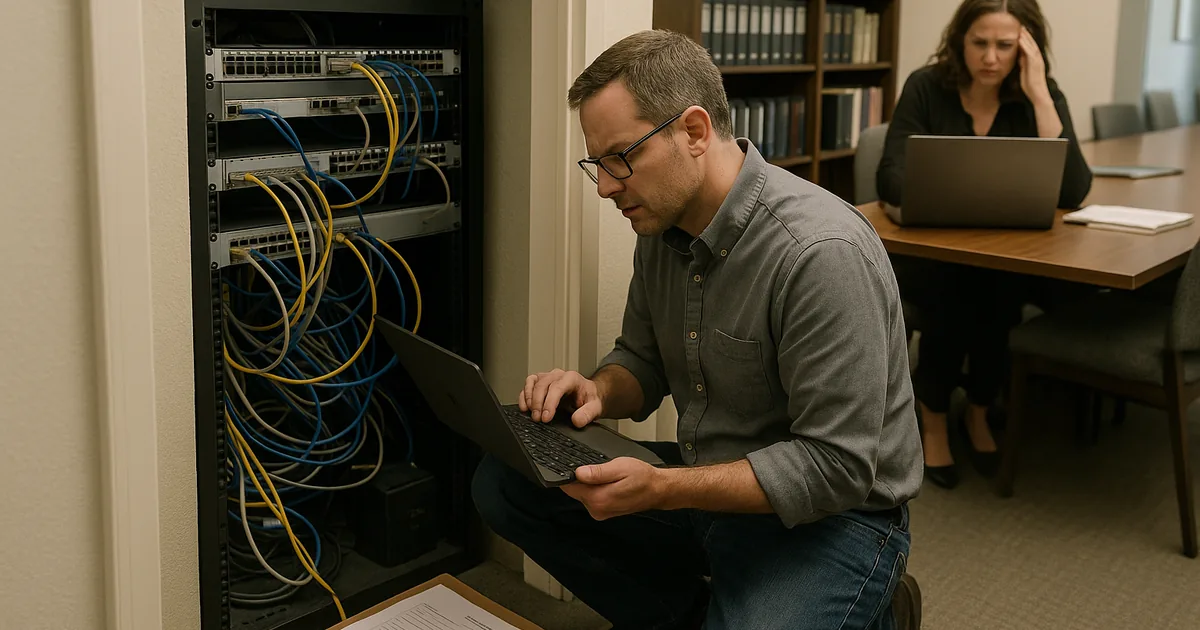
When systems go down in a Washoe County law firm, the immediate question is usually whether the internet failed, a server crashed, or a software vendor had a bad day. In practice, we often find a broader scalability ceiling. The firm has added staff, remote access, case management tools, printers, conference room devices, and security products, but the underlying design still reflects a much smaller operation. That mismatch creates slow logins, unstable file access, overloaded wireless coverage, and inconsistent endpoint behavior that eventually surfaces as a full interruption.
Legal environments are especially sensitive to this pattern because nearly every workflow depends on predictable access to documents, email, calendaring, billing, and secure client communications. In Reno and across Washoe County, firms expanding into additional suites, hybrid work, or satellite coordination often benefit from managed IT support in Reno that focuses on standardization before the next hiring wave lands. The warning signs usually appear well before a hard outage: rising ticket volume, aging switches, unmanaged laptops, fragmented permissions, and backup jobs that have never been tested against current data volume. That is the point where growth starts crashing into infrastructure limits rather than being supported by them.
- Endpoint sprawl: New laptops, home devices, mobile phones, and shared workstations are added faster than they are documented, patched, or brought under a consistent policy set.
- Underplanned infrastructure: Internet circuits, firewall throughput, switching capacity, and wireless design may have been adequate for a 10-person office but not for the next 10 hires and their daily document traffic.
- Inconsistent standards: Different onboarding methods, uneven MFA enforcement, and mixed storage practices create hidden failure points that only become obvious during a busy court filing or billing cycle.
- Operational consequence: What looked isolated for Kara was actually a capacity and governance problem that had been building for months.
How We Remediate the Scalability Ceiling Before It Becomes Repeated Downtime
The fix is not a single reboot or a one-time hardware swap. We start by mapping how the firm actually works: users, locations, applications, file paths, remote access patterns, and peak usage windows. From there, we identify where throughput, authentication, storage, or endpoint management is lagging behind headcount and workflow growth. In law firms, that usually means tightening identity controls, standardizing endpoints, validating backup scope, and redesigning network segments so document systems, voice traffic, and general office traffic are not competing in the same uncontrolled way.
Remediation also has to include recovery planning. If a firm is already near capacity, a single failed switch, bad update, or corrupted file share can create a much larger interruption than leadership expects. That is why we pair infrastructure cleanup with disaster recovery planning for business operations and align controls with practical guidance from CISA . The goal is straightforward: reduce failure points, shorten recovery time, and make the environment capable of supporting the next stage of hiring rather than breaking under it.
- Capacity review: Measure firewall load, switch utilization, wireless density, storage growth, and application dependencies against projected staffing, not just current usage.
- Endpoint standardization: Bring all firm-owned systems into a managed baseline with patching, EDR, encryption, MFA, and documented ownership.
- Network segmentation: Use VLAN separation and policy controls so legal applications, guest traffic, printers, and voice systems do not create unnecessary contention or lateral risk.
- Backup validation: Confirm that backup jobs cover current matter data, cloud workloads, and restore testing, not just legacy server folders.
- Alerting improvements: Set thresholds for storage, failed backups, authentication anomalies, and device health so the firm sees strain before users report outages.
Field Evidence: Stabilizing a Growing Washoe County Legal Office
We worked with a professional office corridor environment in the Reno market where staff growth had outpaced the original network design. Before remediation, the firm was seeing recurring morning slowdowns, intermittent document management disconnects, and backup windows that were running into business hours. The office had added attorneys and support staff quickly, but switching, wireless coverage, and endpoint governance had not been rebuilt to match the new load.
After standardizing endpoints, replacing an undersized core switch, separating traffic classes, and tightening backup and continuity controls, the environment became much more predictable. In a region where weather events, utility interruptions, and multi-site travel between Reno, Sparks, and Carson City can complicate response time, firms also benefit from compliance-focused IT management that keeps recovery expectations realistic and documented.
- Result: Repeated morning performance complaints dropped by more than 70 percent, backup success rates moved to consistent verified completion, and the firm had a documented recovery path for core legal systems instead of relying on ad hoc troubleshooting.
Scalability Risk Review for Law Firm IT Environments
Scott Morris is an experienced IT and cybersecurity professional with 16 years of hands-on experience in managed technology services. He specializes in Managed It Services and has spent his career building practical recovery, security, and operational continuity processes for businesses across Washoe County and Northern Nevada.


About the Author: Scott Morris
Local Support in Washoe County
We regularly support firms in Reno, Sparks, and nearby professional corridors where growth can outpace the original office network faster than leadership expects. From our Ryland Street location, the route to the University area is typically short enough to support practical onsite response when a legal office needs direct troubleshooting, infrastructure review, or recovery coordination.
Plan for the Next Stage of Growth Before Systems Start Falling Over
For law firms in Washoe County, systems going down is often less about a sudden isolated failure and more about steady growth pushing past old technical assumptions. If the network, endpoint standards, backup scope, and recovery process were built for a smaller office, the next hiring cycle can expose weaknesses quickly. That is why scalability has to be treated as an operational planning issue, not just a hardware refresh decision.
The practical takeaway is simple: review capacity before adding headcount, standardize devices before exceptions pile up, and test recovery before a busy filing or billing period forces the issue. Firms that do this early usually avoid the pattern of recurring outages, reactive spending, and preventable workflow disruption.