Reno Encryption Fail
Problems like this tend to stay hidden until something important breaks. For manufacturing plants in South Meadows, that often means encrypted files, avoidable delays, or a bigger recovery burden than expected. The best response is validating backups regularly and proving recovery before a real outage.
This case study reflects real breakdown patterns documented across 300+ regional IT incidents. Names and identifying details have been modified for confidentiality, while technical and financial data remain accurate to the original events.

Why Encrypted Files Become a Resilience Test Failure

When files are encrypted at a South Meadows manufacturing plant, the immediate question is not whether a backup exists. The real question is whether the business can restore the right systems, in the right order, fast enough to keep production, shipping, and billing moving. That is the difference between a backup copy and actual continuity. A resilience test exposes whether the plant can recover shared folders, ERP data, workstation access, print queues, and line-of-business applications without improvising under pressure.
We typically find that manufacturers assume their backup platform is covering the risk when it may only be protecting raw data blocks. If restore testing has not validated permissions, application dependencies, mapped drives, and recovery sequencing, the plant can still be effectively down. That is why business continuity and backup compliance in Northern Nevada matters more than a simple backup status report. In cases like Marissa’s, the backup job may show green while the actual restore path fails under real operating conditions.
- Untested recovery order: File servers, authentication services, production workstations, and shared applications often depend on each other. If they are not restored in sequence, staff may see data present but still be unable to open, print, edit, or route critical documents.
- Missing dependencies: Manufacturing environments frequently rely on local shares, scanner paths, label printers, and older software connectors that are not obvious until a restore is attempted.
- False backup confidence: A successful backup log does not confirm that credentials, retention points, or application-consistent snapshots will support a usable recovery.
- Operational impact: In South Meadows and across Reno industrial corridors, even a few hours of lost access can disrupt receiving, production scheduling, outbound freight timing, and same-day invoicing.
How to Fix the Gap Before the Next Encryption Event
The practical fix is to treat recovery as an operational process, not a storage feature. Start by identifying the systems that must come back first for the plant to function: identity services, file storage, ERP or scheduling tools, print services, and any workstation groups tied to production or shipping. Then run documented restore tests against those systems on a schedule, with signoff from both IT and operations. For plants with aging equipment, mixed Windows environments, or vendor-managed software, this should be part of broader IT planning and budgeting for Reno operations so recovery priorities are funded before an incident exposes the gap.
We also recommend aligning restore testing with recognized guidance from CISA’s ransomware resilience recommendations . That means validating offline or immutable copies where possible, confirming recovery time objectives, and testing whether restored systems can actually support production workflows. For manufacturing plants, the goal is not just to recover data. It is to restore the ability to work.
- Restore validation: Perform scheduled test restores of file shares, application data, and user access rights into an isolated environment.
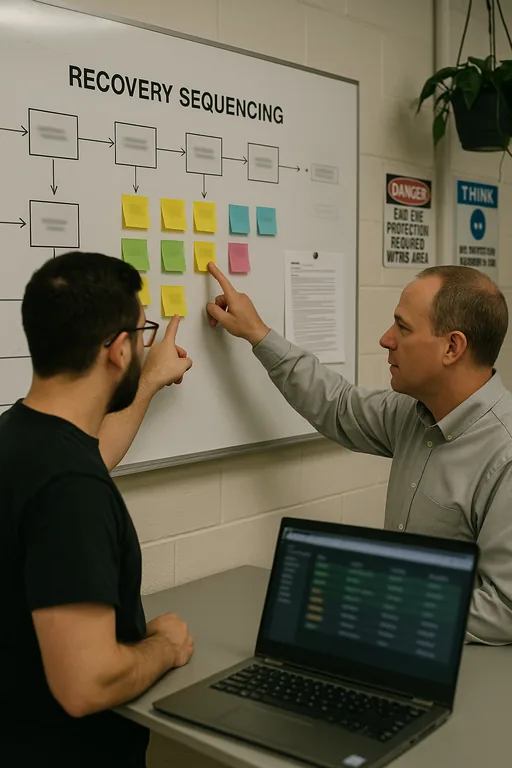
- Recovery sequencing: Document the order for domain services, storage, line-of-business applications, printers, and endpoints so plant staff are not guessing during an outage.
- Backup integrity controls: Use immutable retention, alerting on failed jobs, and periodic checksum or integrity review to catch silent backup issues early.
- MFA and endpoint hardening: Reduce the chance of encryption spreading by tightening privileged access, remote access controls, and endpoint detection coverage.
Field Evidence: Restore Testing Changed the Recovery Window
In one Northern Nevada manufacturing environment near the airport and South Meadows freight routes, the initial state was familiar: backups existed, but nobody had recently tested a full restore of the file server plus the application shares used by scheduling and shipping. The first recovery drill exposed broken permissions, missing printer mappings, and a dependency on an older database service that was not included in the documented plan.
After remediation, the business moved to quarterly recovery testing with written runbooks, role assignments, and infrastructure review tied to technology advisory for multi-system operations . The next validation cycle restored the core file environment and user access in a controlled window instead of a day-long scramble. That kind of before-and-after result is what separates a backup product from a continuity process.
- Result: Recovery testing reduced estimated file-service restoration time from more than 9 hours to under 2.5 hours, with shipping documents, shared production folders, and print workflows verified before the next disruption.
Resilience Test Reference Points for Manufacturing Backup Recovery
Scott Morris is an experienced IT and cybersecurity professional with 16 years of hands-on experience in managed technology services. He specializes in Business Continuity And Backup Compliance and has spent his career building practical recovery, security, and operational continuity processes for businesses across Reno, Sparks, Carson City, and the greater Northern Nevada region and Northern Nevada.

About the Author: Scott Morris
Local Support in Reno and South Meadows
Manufacturing companies in South Meadows, the airport corridor, and nearby industrial sites often need fast, practical support when recovery testing exposes a real continuity gap. From our Reno office, we regularly work with businesses that need to validate backup performance, recovery order, and operational dependencies before a file encryption event turns into a longer production interruption.
The Real Takeaway from a Failed Resilience Test
Encrypted files are often the event that reveals a deeper continuity problem, not the whole problem itself. For manufacturing plants in South Meadows, the real risk is assuming that a successful backup job means the business can actually restore production-critical systems, user access, and document flow under pressure.
A tested recovery process is what reduces downtime, protects scheduling, and limits the operational drag that follows an outage. If restore order, dependencies, and validation steps are still unclear, that is the issue to fix before the next disruption forces the answer.