
Managed Cybersecurity Services in Truckee, California

Managed cybersecurity services help Truckee businesses watch systems continuously, contain threats faster, tighten identity and device controls, and support recovery when something fails, so day-to-day operations, customer trust, and compliance work are less likely to be disrupted.
At a Truckee construction office, Andres M. lost access to vendor payment threads after a compromised Microsoft 365 account created hidden forwarding rules and changed authentication settings; two days of disrupted billing, forensic work, and fraud exposure pushed the operational loss to $68,100.
The following scenario is based on a redacted real-world business IT incident pattern. Identifying details have been changed for privacy, but the disruption sequence and cost impact remain realistic.

About the Author: Scott Morris
Scott Morris is an experienced IT and cybersecurity professional with 16 years of hands-on experience in managed technology services. He specializes in Managed Cybersecurity Services in Truckee, California and has spent his career building practical recovery, security, and operational continuity processes for businesses across Nevada.
This article explains the operational controls, failure points, and evaluation questions that matter when a business is comparing cybersecurity oversight. This is general technical information; specific network environments and compliance obligations change strategy.
Managed cybersecurity services in Truckee, California is an operating model, not a product. It combines security monitoring, endpoint controls, identity protection, patch discipline, email defense, and incident handling with the same ownership and accountability expected from managed IT support in Truckee.
In practice, the issue is rarely the tool alone; it is the process around it. A common failure point is poor asset visibility: laptops bought outside procurement, old vendor accounts left active, firewall rules that no one revisits, and cloud administrators shared among multiple people. Mature managed IT services keep an accurate asset inventory, map privileged access, and assign ownership so alerts can be investigated before a small anomaly turns into a payroll, file access, or payment problem.
For many Truckee businesses, the highest-risk perimeter is not the office network but the user identity and the unmanaged exception. Seasonal hiring, remote logins, personal devices used for emergency access, and older line-of-business software create openings that antivirus alone does not close. Managed cybersecurity adds enforcement, review cadence, and response workflows so security remains tied to uptime, documentation, and recoverability.
What are managed cybersecurity services for a Truckee business?

Managed cybersecurity services are the day-to-day security operations wrapped around business IT: account protection, endpoint detection and response, secure email filtering, vulnerability management, log review, and documented incident handling. A common failure point is assuming the software license equals protection; in mature environments, the value comes from policy enforcement, alert triage, and someone clearly accountable for containment, communication, and recovery when an issue starts moving.
Why does it matter to everyday operations in Truckee?
It matters because most business disruption now starts with normal systems being used in abnormal ways: a finance inbox forwarding mail externally, a stale remote access account reused after turnover, a laptop missing months of security updates, or a cloud admin session coming from an unusual location. In businesses where owners, staff, vendors, and remote workers may all touch the same systems, even a short control failure can interrupt quoting, scheduling, invoicing, customer communication, or access to shared files long before anyone uses the word breach.
Which risks do managed cybersecurity services actually reduce?
The main risks are account takeover, business email compromise, malware execution, unauthorized remote access, and silent persistence after an employee or vendor relationship ends. Guidance in NIST SP 800-63B matters here because strong authentication is not only about password length; it is about identity proofing, multifactor enforcement, recovery methods, and the full account lifecycle. In business terms, that reduces the chance that one reused password or weak reset workflow becomes vendor fraud, data exposure, or lateral movement into systems that keep the company operating.
How does managed cybersecurity work in practice day to day?
Day to day, a competent provider enrolls endpoints into security policy, monitors alerts, correlates sign-in and device activity, isolates suspicious machines when needed, opens documented incident tickets, and tracks remediation through closure. During a routine endpoint review, repeated PowerShell alerts from a bookkeeper workstation first looked like noise; the underlying issue was an old scan utility that had been left with local administrator rights, while the device had stopped reporting update status weeks earlier. That type of discovery is common in inherited environments, and the control that prevents it is not one tool but a chain of configuration baselines, alert ownership, patch enforcement, and exception records that show what changed, who approved it, and when the risk was removed.
How can a business tell whether a provider is operating competently?
- Asset accuracy: Ask for a current inventory of workstations, servers, cloud tenants, and privileged accounts; if that list is outdated, security coverage is already incomplete.
- Patch evidence: A mature environment produces patch compliance reports showing which devices are current, which failed, which were deferred, and who approved the exceptions.
- Response records: Alert escalation logs and incident timelines should show when alerts were received, who reviewed them, what was contained, and how closure was validated.
- Access review: Regular review reports should document new administrators, removed users, dormant accounts, and vendor access decisions, not just an assumption that someone handled them informally.
When does weak implementation become dangerous?
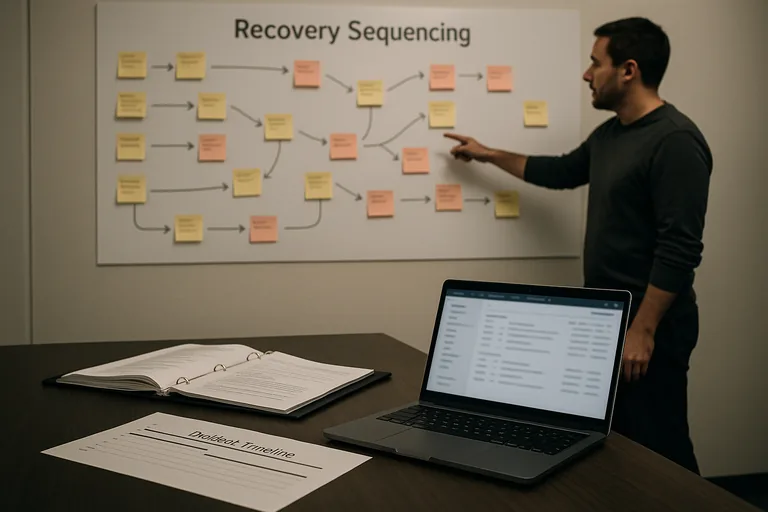
Weak implementation becomes dangerous when controls exist on paper but are not enforced: multifactor authentication enabled for some accounts but not all, endpoint software installed but devices not actually checking in, or backups available while nobody knows which systems must be restored first. During incident response, it is common to discover that the security stack was treated separately from managed operations discipline, so the provider cannot tie an alert to an owner, a device to a business function, or a compromised account to a clean recovery sequence. That is when a containable event becomes extended downtime, because the business is trying to reconstruct documentation and responsibilities during the incident instead of before it.
What should a Truckee business do next?
Start with evidence, not promises: confirm the current asset inventory, privileged account list, multifactor enforcement status, patch compliance, alert escalation workflow, and recent incident or restore testing records. If those records do not exist or cannot be explained clearly, the next step is a structured review of identities, endpoints, remote access, and business continuity priorities so leadership knows where exposure is highest and which controls need ownership first.