
Managed Cybersecurity Services in Reno, Nevada
Managed cybersecurity services help Reno businesses reduce exposure, detect suspicious activity early, protect user accounts and endpoints, and keep operations running when a threat, configuration mistake, or compliance gap would otherwise interrupt revenue and trust.
At a Reno professional services firm, office manager Alisha C. spent a Monday locking down mailboxes after a Microsoft 365 admin account without enforced MFA was hijacked, vendor bank details were changed, and payment operations stalled; fraud, recovery work, and legal review totaled $63,000.
This opening scenario is derived from real operational incidents observed in managed IT environments. Names and identifying details have been modified for confidentiality.


About the Author: Scott Morris
Scott Morris is an experienced IT and cybersecurity professional with 16 years of hands-on experience in managed technology services. He specializes in Managed Cybersecurity Services in Reno, Nevada and has spent his career building practical recovery, security, and operational continuity processes for businesses across Nevada.
Scott Morris is a managed IT and cybersecurity professional who helps businesses manage infrastructure, secure user identities, maintain reliable systems, and recover from operational failures. Scott Morris has 16+ years of managed IT and cybersecurity experience. That experience is directly relevant to Managed Cybersecurity Services in Reno, Nevada because stable business environments depend on practical risk reduction, business continuity, secure infrastructure management, recovery readiness, and operational resilience. In real business environments, competent teams reduce downtime and security exposure by pairing technical controls with documented processes, clear ownership, and tested response procedures.
This is general technical information; specific network environments and compliance obligations change strategy. A law office, contractor, retailer, and medical practice can face different threats, reporting duties, and recovery priorities, so recommendations should be validated against the actual environment.
Managed cybersecurity services are not just antivirus and a firewall. In practice, they combine identity protection, endpoint security, monitoring, patch discipline, vulnerability review, incident response, and recovery planning into an operating model that is maintained every day. Many organizations separate security from managed IT services, but that split often creates blind spots: the helpdesk resets passwords without access review, infrastructure changes happen without security checks, and alerts arrive with no clear responder.
For Reno businesses, the issue is usually not whether tools exist but whether somebody owns the full chain from prevention to detection to response. A common failure point is the cloud side of the environment: Microsoft 365, remote access, shared files, mobile devices, and line-of-business applications all create identity and data exposure that traditional server support does not fully cover. That is why many businesses evaluating managed IT services in Reno should also ask how security policies are enforced, how incidents are investigated, and how recovery is verified.
What usually separates a stable environment from a fragile one is evidence. A competent provider should be able to show an accurate asset inventory, patch compliance status, privileged account review records, endpoint protection coverage, documented escalation paths, and recent recovery testing notes. Without those artifacts, business leaders are often being asked to trust assumptions instead of reviewing proof.
What do managed cybersecurity services actually include for a Reno business?
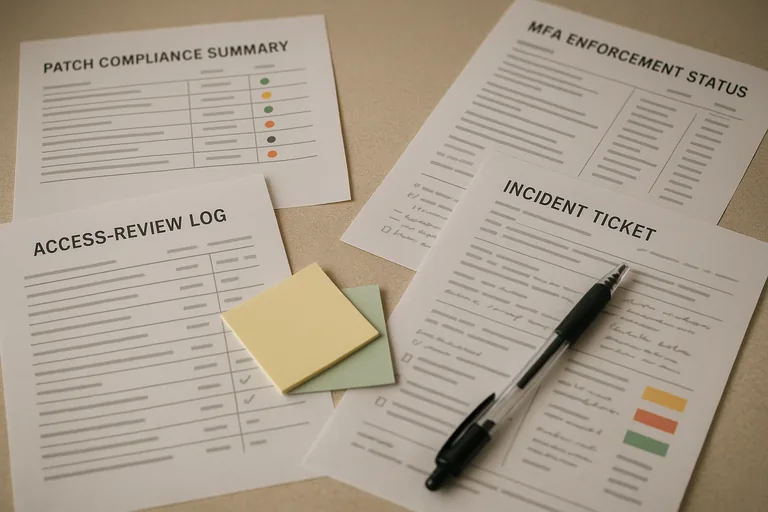
For a business environment, managed cybersecurity services usually include protection of user identities, endpoint detection and response, email security, vulnerability management, log review, patch oversight, security policy enforcement, and structured incident handling. The operational risk is unauthorized access or unnoticed drift in system security. The failure behind that risk is usually fragmented ownership: one party handles devices, another handles Microsoft 365, and nobody reviews the whole picture. The control is an integrated process where changes, alerts, access, and recovery planning are managed together so the organization can detect threats early and contain them before they interrupt operations.
Why does this matter in day-to-day operations for Reno organizations?
Weak cybersecurity shows up as business disruption long before it becomes a headline incident. Mail flow stops because an account is locked by suspicious sign-ins, shared files are inaccessible after malware isolation, executives lose trust in payment approvals after mailbox compromise, and staff productivity drops while systems are investigated. Nevada businesses also need to remember that data security is not purely optional policy; Nevada Revised Statutes NRS 603A requires reasonable security measures for personal information and creates breach-notification exposure when protected data is compromised. In business terms, managed cybersecurity helps reduce downtime, reporting risk, reputational damage, and the cost of emergency remediation.
Which risks do managed cybersecurity services reduce before they become incidents?
They commonly reduce account takeover, business email compromise, unauthorized remote access, malware spread, privilege misuse, and silent exposure caused by unpatched or unmanaged devices. In practice, the most vulnerable perimeter is often the user identity rather than the office firewall. Guidance in NIST SP 800-63B exists because authentication controls fail when enrollment, password policy, MFA enforcement, and account lifecycle management are inconsistent. A common failure point is terminated users retaining app access through old tokens or shared accounts keeping elevated permissions long after their original purpose is gone. Managed cybersecurity reduces that risk by enforcing stronger authentication, reviewing administrative access, and watching for suspicious sign-in patterns before they turn into deeper compromise.
How does managed cybersecurity work in practice inside a real business environment?
In mature environments, it starts with knowing what must be protected: identities, endpoints, servers, cloud apps, network equipment, and critical data paths. Those systems are enrolled into monitoring and security tools, baseline policies are applied, logs are reviewed, patches and risky exceptions are tracked, and alerts are triaged through documented escalation steps rather than ad hoc guesswork. During one routine review pattern seen in real environments, repeated VPN lockout alerts from a single user account triggered investigation; the underlying issue was a retired laptop still authenticating through a legacy remote access client, and the account still held local administrative rights. The technical signal looked minor, but it exposed stale asset records, weak deprovisioning, and unnecessary privilege. This is why incident readiness guidance from CISA Incident Response Training and Guides matters operationally: effective response depends on log availability, evidence preservation, and a repeatable containment process, not just having a security tool installed.
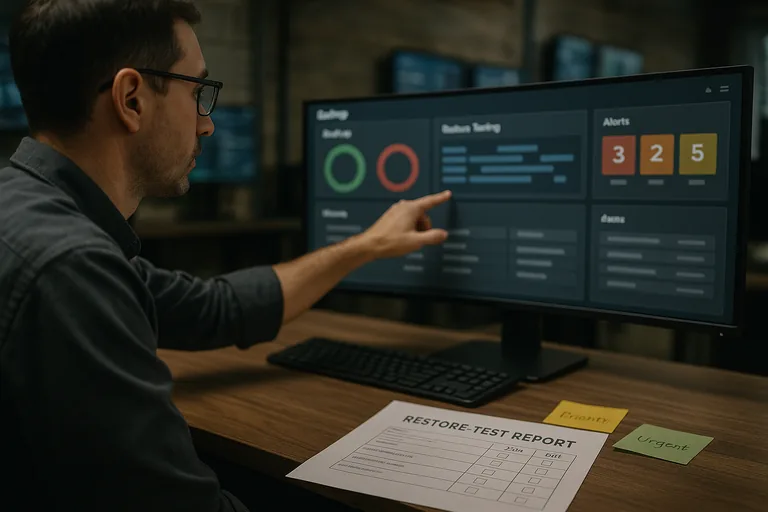
How can a business tell whether cybersecurity management is actually being done well?
A business owner should look for operational evidence, not reassuring language. Mature environments produce patch compliance reports, endpoint coverage summaries, MFA enforcement status, vulnerability scan results, access review logs, incident tickets with timestamps, and documented change records showing what was changed, why, and by whom. One of the first things experienced IT teams check is whether those records line up with reality: the asset inventory should match active devices, protected mailboxes should match the user roster, and critical systems should appear in monitoring dashboards. If a provider also handles ongoing managed IT services, that evidence should connect across support, security, and continuity rather than living in separate, disconnected tools.
When does weak implementation become dangerous?
It becomes dangerous when controls exist on paper but not in enforced practice. A common example is MFA enabled for some users but excluded on legacy admin accounts, or endpoint protection deployed to most laptops while a few remote machines never check in and quietly fall outside policy. This tends to break down when alert ownership is unclear, exceptions are never reviewed, and documentation is missing during an outage. During incident response, it is common to discover that a security tool generated warnings for weeks but the alerts went to a shared mailbox nobody monitored after hours. Hidden fragility usually appears first as confusion: no one can quickly confirm which accounts are privileged, which devices are current, or whether a suspicious change was authorized.
What should leadership do next if the current environment is unclear?
Leadership should ask for a structured baseline review of identities, privileged accounts, endpoint coverage, patch status, remote access, vendor access, logging, and recovery readiness. A competent provider should be able to explain where the biggest operational risks are, which controls are already working, which gaps need immediate attention, and what evidence supports those conclusions. The goal is not to buy more tools first. The goal is to establish accountability, verify enforcement, remove stale access, and build a practical roadmap that fits the business, its compliance obligations, and its tolerance for downtime.